

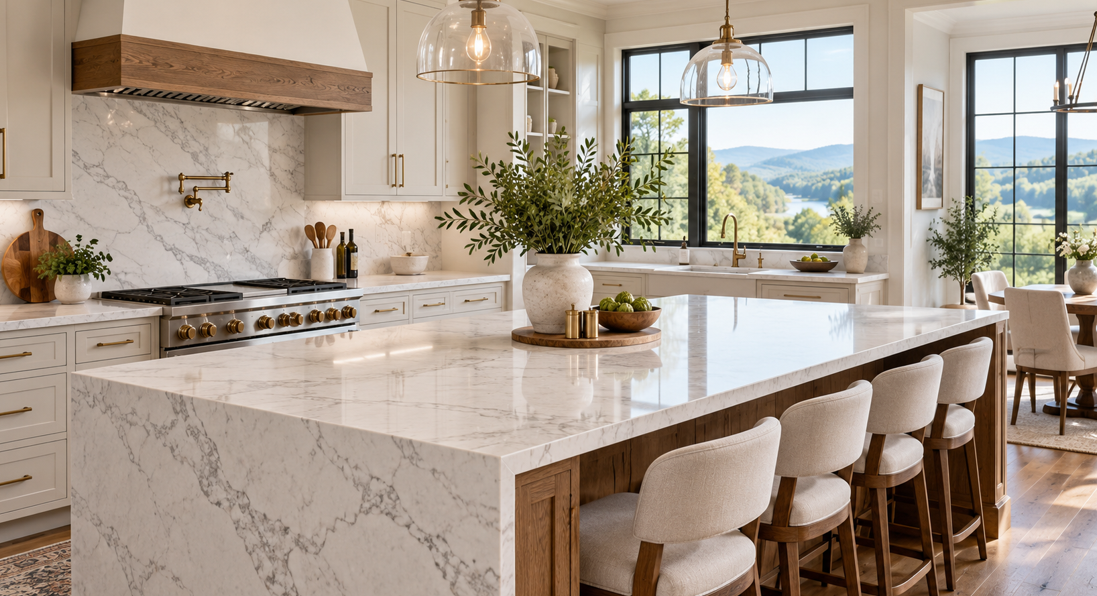
Choosing a countertop is one of the most important decisions in a kitchen renovation. The surface needs to complement the cabinetry and overall design, but it also has to perform through food preparation, family meals, entertaining, cleaning, and everyday use.
For many Orange County homeowners, quartz continues to offer that balance beautifully.
Engineered quartz remains the most frequently selected countertop material among homeowners upgrading their kitchens in the 2026 U.S. Houzz Kitchen Trends Study. Its continued popularity makes sense: quartz offers an extensive range of colours and patterns, a refined appearance, low routine maintenance, and the consistency that many homeowners appreciate when designing an entire kitchen around one surface.
The aesthetic is evolving too. Today's quartz countertops can move far beyond the uniform grey-and-white looks associated with earlier kitchen trends. Warm creams, soft taupes, natural-stone-inspired movement, and expressive veining are giving homeowners more opportunities to create kitchens with depth and character.
At Dash Cabinetry, countertops are considered as part of the complete kitchen composition — alongside cabinetry, hardware, storage, flooring, lighting, and the way the room functions every day.
If you are considering quartz for an Orange County or Hudson Valley kitchen, here is what to know before selecting your surface.
Why Quartz Remains the Leading Countertop Choice in 2026
Kitchen trends change, but homeowners continue to prioritise a combination of appearance and practicality.
That is where quartz remains particularly competitive.
According to the 2026 U.S. Houzz Kitchen Trends Study, engineered quartz accounts for 32% of new or upgraded countertops among surveyed renovating homeowners, keeping it ahead of granite, quartzite, butcher block, soapstone, laminate, and marble.
Its share has declined from previous years as homeowners explore a wider selection of natural and alternative materials, but quartz remains the single most frequently chosen countertop material.
That distinction is important.
Quartz is no longer successful because every kitchen is trying to achieve the same polished white-and-grey aesthetic. It remains successful because manufacturers now offer increasingly diverse looks while retaining the practical characteristics that made the material popular in the first place.
For Hudson Valley homeowners, those characteristics can work across a remarkably broad range of kitchen styles.
A warm quartz with subtle movement can complement natural white oak cabinetry. A dramatic veined design can become the focal point of a large island. A quiet off-white surface can allow rich walnut or painted cabinetry to take visual priority.
The material adapts to the design rather than forcing the entire room in one direction.
What Is an Engineered Quartz Countertop?
Understanding what quartz is helps homeowners compare it more accurately with natural stone.
Quartz countertops are manufactured surfaces containing mineral content combined within an engineered slab. Unlike granite, marble, or quartzite, the finished countertop is not cut directly from one naturally formed block of stone.
The manufacturing process allows greater control over colour, pattern, and consistency.
That distinction creates several of quartz's most recognisable characteristics.
More Predictable Colour and Pattern
Natural stone is inherently variable.
Two slabs from the same stone type can contain significant differences in colour, veining, mineral deposits, and movement.
For homeowners who love that unpredictability, natural stone can be exceptional.
For those who want greater consistency across a long countertop run, perimeter surfaces, or a large island, engineered quartz can be easier to plan around.
A sample can generally provide a useful indication of the overall design, although viewing a larger slab or full-scale representation is still valuable when the pattern contains prominent veining.
A Broad Range of Design Options
Because quartz is engineered, it can be produced in colours and patterns that range from remarkably quiet to visually dramatic.
Options may include:
Soft white
Warm cream
Beige and taupe
Grey
Charcoal and black
Fine-speckled surfaces
Subtle marble-inspired veining
Bold directional movement
Quartzite-inspired patterns
Warm stone-inspired designs
This variety makes quartz suitable for kitchens where the countertop needs either to recede quietly or become a defining feature.
Warm Quartz Countertops Are Replacing Cooler Grey Looks
One of the clearest countertop directions in 2026 is the move towards warmth.
Cool grey interiors that dominated previous renovation cycles are giving way to creams, sands, beiges, taupes, warm whites, and softer stone-inspired palettes.
Quartz manufacturers are responding with surfaces that feel less stark and more connected to natural materials.
Warm White Rather Than Bright White
White remains highly versatile, but the undertone matters.
A very bright, cool white can create a crisp contemporary effect. In kitchens incorporating warm wood cabinetry, brass hardware, beige flooring, or creamy walls, however, a softer white may create a more cohesive result.
Warm white quartz can provide the brightness homeowners appreciate without making the room feel overly sharp.
It works particularly well with:
White oak cabinets
Walnut cabinets
Warm painted cabinetry
Forest green
Deep blue
Cream and off-white cabinets
Aged brass or bronze hardware
For many Orange County kitchens, these softer combinations also complement the broader movement towards interiors that feel comfortable, layered, and connected to natural surroundings.
Beige and Taupe Are Becoming More Refined
Beige is no longer limited to the heavily patterned surfaces associated with older kitchens.
Current quartz designs use warm neutral backgrounds with far more restrained movement, allowing beige, sand, mushroom, and taupe tones to feel contemporary.
These colours can create a useful bridge between cabinetry, flooring, backsplash tile, and surrounding living spaces.
For open-plan Hudson Valley homes, that continuity can be especially valuable because the kitchen is often visible from dining and gathering areas.
Quartz Can Deliver the Look of Natural Stone with Greater Consistency
Natural stone remains desirable precisely because every slab is unique.
Quartz approaches the aesthetic from another direction.
Many 2026 quartz surfaces are inspired by marble and quartzite, using broader veining, subtle tonal variation, and softer movement to create greater visual depth.
Quartzite-inspired looks are particularly relevant this year as warm, flowing natural-stone patterns become more prominent in kitchen design.
Subtle Veining Creates an Understated Kitchen
Not every countertop needs to become the focal point.
A soft quartz with delicate veining can provide enough movement to prevent the surface from appearing flat while allowing cabinetry, lighting, or architectural details to take centre stage.
This approach works particularly well when the kitchen already contains strong materials.
For example, walnut cabinetry has significant colour and grain variation of its own. Pairing it with restrained quartz allows the wood to remain prominent.
The same principle can apply to deep green, navy, or charcoal cabinetry.
Dramatic Veining Turns the Countertop into a Feature
At the other end of the spectrum are quartz designs with large-scale, expressive veining.
These can create the impression of movement across an island or long countertop run and are particularly effective in kitchens where the surface is intended to become a visual statement.
For homeowners considering new kitchen countertops, viewing a larger section of the chosen pattern is worthwhile. A small sample may reveal the background colour accurately but cannot always communicate the scale or direction of dramatic veining.
Planning the slab layout also becomes more important when the design includes strong movement.
Quartz Is a Practical Choice for Busy Kitchens
Appearance may begin the countertop conversation, but everyday function often determines whether a homeowner remains satisfied with the selection.
Quartz is widely valued because routine care is relatively straightforward.
The surface is nonporous, so it does not require the periodic sealing associated with many natural stones. For households where the kitchen sees frequent cooking, food preparation, and entertaining, that can be a meaningful advantage.
Everyday Cleaning Is Straightforward
For routine care, gentle cleaning methods are generally appropriate.
Wiping spills promptly and using manufacturer-approved products helps preserve the appearance of the surface.
Specific care guidance can differ between products, so following the recommendations supplied for the selected quartz is worthwhile rather than assuming every engineered surface has identical requirements.
Quartz Resists Many Common Stains
Its nonporous nature makes quartz resistant to many everyday staining concerns.
Coffee, sauces, oils, and other kitchen ingredients still benefit from prompt cleaning, but homeowners do not have to manage the same sealing routine associated with certain porous natural stones.
For families using the kitchen extensively throughout the week, this low-maintenance quality is one of quartz's strongest practical arguments.
Is Quartz Heatproof? Understanding Its Limitations
Quartz is durable, but durable does not mean indestructible.
One of the most important considerations is heat.
Because engineered quartz contains manufactured binding materials, very hot cookware can damage the surface.
Rather than placing hot pans, baking trays, or cookware directly onto quartz, using trivets or other protective barriers is an excellent everyday habit.
This is a meaningful difference when comparing quartz with certain natural stones.
Homeowners who cook extensively can still find quartz highly practical, but the way the countertop is used matters.
Cutting Directly on Quartz Is Also Worth Avoiding
Quartz is hard and resistant to normal daily wear, but a cutting board remains the better surface for chopping and food preparation.
This protects both the countertop finish and kitchen knives.
As with any premium kitchen material, thoughtful everyday care helps preserve the appearance of the investment.
Quartz vs. Granite: Which Is Better for an Orange County Kitchen?
Granite remains an established natural-stone choice, and both materials have genuine strengths.
The better option depends on what the homeowner values.
Choose Quartz When You Prefer:
Greater pattern consistency
Low routine maintenance
No periodic sealing requirement
A very broad colour range
Predictable coordination across the kitchen
Natural-stone-inspired designs with engineered consistency
Consider Granite When You Prefer:
Genuine natural stone
One-of-a-kind mineral variation
The character of an individual slab
Greater tolerance of heat than engineered quartz
Natural variation as part of the design
Neither material is universally superior.
A homeowner who wants a consistent warm-white surface throughout an expansive kitchen may find quartz exceptionally convenient.
Someone who becomes captivated by the movement and mineral character of a particular granite slab may reasonably prefer natural stone.
The selection is ultimately about matching the material to the homeowner's design priorities and lifestyle.
Quartz vs. Quartzite: Do Not Confuse the Two
Quartz and quartzite sound similar, but they are fundamentally different countertop materials.
Quartz is an engineered surface.
Quartzite is natural stone quarried from the earth and fabricated into countertops.
This distinction affects appearance, maintenance, variation, and the purchasing process.
Quartz provides greater consistency and does not require the same sealing considerations associated with many natural stones.
Quartzite offers genuine geological variation and can deliver exceptional depth, movement, and individuality.
Quartzite-inspired engineered surfaces are becoming increasingly sophisticated, but they remain engineered products rather than natural quartzite.
For homeowners comparing the two, seeing actual samples — and ideally full slabs where appropriate — is far more useful than making the decision from online photographs.
How to Pair Quartz Countertops with Cabinet Colours
The countertop and cabinetry occupy so much visual space that they need to work together from the beginning.
Selecting them independently can make it harder to create a unified palette.
White Oak Cabinets
White oak pairs especially well with warm white, cream, beige, and softly veined quartz.
For greater contrast, charcoal or deeper quartz can create a more architectural appearance.
Walnut Cabinets
Walnut already provides strong grain and rich colour.
A restrained cream or warm-white quartz often allows the wood to remain the focus.
Quartz with subtle brown, taupe, or warm-grey movement can connect naturally with walnut's tonal variation.
White and Cream Cabinets
Light cabinetry creates considerable flexibility.
A quiet quartz can produce a serene, tonal kitchen, while dramatic veining can introduce a stronger focal point.
Warmer countertop backgrounds can keep an all-light kitchen from feeling cold.
Green and Blue Cabinets
Moody painted cabinetry often benefits from a lighter surface.
Cream, warm white, and stone-inspired quartz can brighten the room while allowing the cabinet colour to maintain its depth.
Brass, nickel, or bronze hardware can then help connect the two materials.
Do Quartz Countertops Work Well on Kitchen Islands?
Yes. In fact, the island is one of the best places to showcase an expressive quartz design.
A large uninterrupted surface allows veining and movement to become more visible than on narrow perimeter counters.
Quartz can also be used to create visual continuity when the same material appears on both perimeter countertops and the island.
Alternatively, homeowners can deliberately contrast the island.
For example, a quiet perimeter countertop might be combined with a more dramatic island surface, or another material could be introduced to distinguish the central gathering space.
Waterfall Edges Create a Contemporary Statement
A waterfall edge extends the countertop material vertically down one or both ends of an island.
Quartz is often suited to this style because patterns can be selected and fabricated to create a continuous visual effect.
The success of a waterfall design depends heavily on pattern placement and fabrication.
With heavily veined quartz, careful alignment can make the feature feel considered and architectural rather than interrupted.
For a more restrained kitchen, a standard edge may provide all the refinement needed.
Choosing the Right Quartz Finish and Edge Profile
Colour receives the most attention, but edge treatment affects the final appearance as well.
An eased or simple straight edge creates a clean look that suits contemporary and transitional kitchens.
More decorative profiles can introduce traditional character.
The appropriate choice depends on the cabinet door style, countertop thickness, island proportions, and overall design direction.
The aim is for the edge to reinforce the kitchen rather than draw unnecessary attention away from the surface itself.
Is Quartz Right for Every Hudson Valley Home?
Quartz is exceptionally versatile, but no countertop material is right for every homeowner.
It is an excellent candidate when the priorities include design flexibility, low maintenance, consistent appearance, and a wide range of colours.
Natural stone may be more appealing when uniqueness, geological character, or the experience of selecting an individual slab is central to the vision.
Other surfaces can also make sense depending on the room, budget, desired style, and intended use.
For that reason, the most useful question is not, “What countertop is the most popular?”
It is, “Which countertop works best for this kitchen?”
A family kitchen used throughout the day may place a premium on straightforward maintenance.
A statement kitchen may prioritise dramatic movement.
A historic Hudson Valley home might call for one material palette, while a newly built contemporary home may invite another.
The right countertop supports both the architecture and the way the household lives.
Why Orange County Homeowners Continue to Choose Quartz
Quartz has remained at the top of the countertop market because it solves several design challenges at once.
It offers homeowners:
An extensive selection of colours and patterns
Options ranging from quiet to dramatic
Greater visual consistency than natural stone
Straightforward routine maintenance
No routine sealing requirement
Compatibility with many cabinet styles
Warm neutral and natural-stone-inspired looks
Strong potential for islands and large countertop runs
In 2026, the most interesting quartz kitchens are moving away from the idea that engineered surfaces have to look uniform or cool.
Warmth is becoming more important.
Creamier backgrounds, taupe movement, softer veining, and quartzite-inspired patterns are helping quartz fit comfortably alongside white oak, walnut, warm painted cabinetry, aged metals, and other materials shaping today's kitchens.
For Orange County and Hudson Valley homeowners, that gives quartz an appealing combination of familiarity and fresh design possibilities.
Find the Right Quartz for Your Orange County Kitchen
A countertop is experienced at close range every day. It becomes the surface where meals are prepared, groceries are unpacked, conversations happen, and countless routines unfold.
That makes the right selection both an aesthetic and practical decision.
Quartz remains the leading countertop choice among renovating homeowners in 2026 because it gives homeowners substantial design freedom while maintaining the approachable everyday qualities that established its popularity.
The best results come from looking beyond the countertop sample in isolation.
Cabinet colour, hardware, flooring, backsplash, lighting, edge profile, island design, and surrounding spaces all influence whether a particular quartz feels right.
Dash Cabinetry helps homeowners bring those selections together through a personalised kitchen design process, including cabinetry, countertop selection, detailed planning, 3D renditions, and professional installation.
Whether your Orange County kitchen calls for warm understated quartz, expressive veining, or a surface inspired by natural stone, the goal is a countertop that complements the room beautifully and supports everyday life.
Ready to explore quartz options for your Hudson Valley kitchen? Schedule a consultation with Dash Cabinetry and begin creating a kitchen where cabinetry, countertops, and thoughtful design work together as one complete vision.

